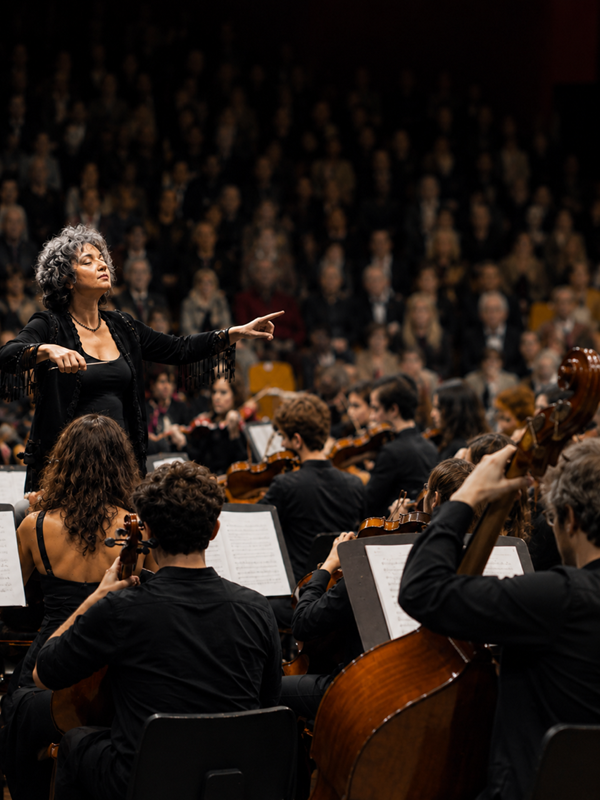
Nana Simopoulos Continues to Redefine
The Musical Language
Interview
by Vassilios Nicolaos Vitsilogiannis
(IG:
@vassiliosvitsilogiannis)
After
four decades of musical exploration, Nana Simopoulos continues to redefine the
boundaries of artistic expression, weaving together cultures, traditions and
sounds into a deeply personal musical language. An acclaimed composer,
guitarist and visionary artist, she has collaborated with legendary musicians,
explored diverse musical landscapes and embraced the expressive possibilities
of orchestral composition and immersive art. Rooted in her Greek heritage yet
inspired by the musical traditions of the world, her work reflects a lifelong
search for connection, emotion and truth. Today, her artistic journey is guided
not by technical virtuosity or recognition, but by the beauty of silence, the
power of melody and music’s
extraordinary ability to unite people across generations and cultures.

After
four decades of composing and performing, how has your relationship with music
changed? What do you hear, feel, or look for in music today that perhaps you
didn’t
when you began your career?
When
I first started, I thought technique, speed, timing and proving what I could do
were the most important things in music. I was focused on getting every note in
its exact right place.
Today,
four decades later, what is important to me has completely changed. What I look
for now is the silence
between the notes, the breathing space and pure honesty. Technical difficulty
doesn’t matter to me anymore; what matters is how much truth and emotion a
piece carries. Today, I hear music with my whole body, not just my ears. I look
for the kind of sound that makes you stop thinking and simply feel.
Your
music has always brought together different cultures, instruments, rhythms and
traditions while maintaining a strong sense of melody. What continues to draw
you toward musical dialogue across cultures and how has your understanding of
that dialogue evolved over the years?
When
I was younger, bringing together different instruments—like the sitar, the
mandolin, or jazz guitar—felt like an adventure. I wanted to see how they
sounded together.
Over
the years, I realized this dialogue between cultures isn’t just an experiment;
it’s the most effective way we have to understand one another. Melody is our
common language. No matter what culture I encounter, when a strong melody is
present, everyone feels the same underlying emotions: joy, sadness, nostalgia.
Today, I’m
not trying to ‘blend’ genres. I let each tradition keep its own distinct color
and beauty, and I just invite them to sit at the same table and talk like old
friends.
You
are now focusing strongly on orchestral music and an upcoming album of original
orchestral works. What is it about the orchestra that speaks to you at this
stage of your life and career and what do you want this new body of work to
express?
The
orchestra is the largest canvas available to me as a composer. At this stage in
my life, I feel I’ve
accumulated so many experiences and memories that I need a big, rich sound to
hold them all.
In
an orchestra, dozens of musicians breathe together, play together, and form a
single, powerful wave of sound. What I want this new body of work to express
above all is unity. I want to show that even though we live in a world filled
with noise, isolation and screens, the human spirit can still come together to
create something beautiful, alive and deeply moving.
Your
collaboration with the Nostos Youth Orchestra brings your music into
conversation with a younger generation of musicians. What have these young
performers taught you and what do you hope they take away from working with
your music?
These
young musicians from the Nostos Orchestra—from the Music School of Alimos—have
given me so much energy! They remind me why I fell in love with music when I
was their age. They’ve taught me to look at music once again with fresh eyes
and pure excitement, free from the fatigue that sometimes comes with a long
career.
What
I hope they take away from working with me is a sense of freedom. I want them
to know that music doesn’t have rigid boundaries and there’s nothing to be
afraid of. You don’t have to put yourself in a box. You can play classical
music while carrying rock energy, zeibekiko rhythms, or Eastern textures inside
you. I want them to feel that music is an open door, and most importantly, I
want to help them discover a deeper, more visceral way of listening—listening
not just with their ears to hit the right notes, but with their whole body and
heart.
You
have recently expanded your work into immersive visual environments, including Perennial Land
at the Morris Museum. How does composing for an installation or digital
landscape change the way you think about melody, silence, space and emotion
compared with writing for the concert stage?
When
you write for the concert stage, the audience sits in rows and looks straight
ahead. But when you write for an installation like Perennial Land,
people walk through the space. The sound isn’t just in front of you—it
surrounds you.
That
completely shifted my approach. It taught me to give music much more space.
Silence became even more crucial. The melody doesn’t need to push forward
constantly; it can float in the air, allowing visitors to feel as though they
are physically living inside the emotion. It’s like building a home out of sound
that someone can walk into, experience and find stillness in.
You
have collaborated with extraordinary artists from very different musical
worlds, from Charlie Haden and Billy Higgins to Ustad Sultan Khan and Dave
Liebman. Looking back, which collaborations changed you most deeply as an
artist and what did you learn from those encounters that remains with you
today?
Every
one of these extraordinary artists reshaped a part of who I am. From Charlie
Haden and Billy Higgins, I learned what true rhythm and ‘deep sound’ mean in
jazz—they taught me to listen with my heart. From Ustad Sultan Khan in India, I
learned about the spiritual side of music and how a single note can bring tears
to your eyes.
What
I learned from all of them—and what stays with me every day—is humility. The
greater the artist, the more humble they are before the music. They didn’t play
for their egos; they played to serve the sound. That is what I try to do every
single day.
Your
career has involved enormous creative commitments—composing, performing,
conducting large multicultural ensembles, teaching and working across film,
theatre, dance and visual art. What role has your family played in making that
life possible and how have the people closest to you influenced your creative
journey?
My
family means everything to me. Without them, none of this would have been
possible. A life in music involves constant travel, long hours of isolation and
a lot of uncertainty. Having people by your side who truly understand you, love
you and support you is the greatest gift.
My
loved ones are my anchor. They keep me grounded when life gets overwhelming.
And the memories of my family—like my grandfather playing the mandolin, or my
parents and their deep roots in Greece—are the very foundation of my music.
Every note I write carries a piece of the love I received from them.
You
began your career in a very different musical and cultural landscape. If you
could speak to the young composer and musician you were at the beginning of
your journey, what would you tell her now—and what do you think she would find
surprising about the artist you have become?
If
I could talk to that young girl just starting, I would tell her: ‘Don’t be
afraid. Trust your heart, be yourself and don’t try to be anyone else. Your
journey is going to be beautiful—just keep working with love.’
I
think she would be completely surprised to see where I am today! She’d
probably be amazed that her guitar found its way to the Indian sitar, but most
of all, she would be thrilled to see herself conducting a symphony orchestra in
Greece, performing her own compositions. She would be proud that she never lost
her passion.
At
this point in your life, what are you still curious about? Are there musical
territories, collaborators, instruments, forms, or artistic disciplines that
you feel you have yet to explore?
I
am still curious about everything! Curiosity is what keeps us young. And I
learn new things every day.
I
want to keep exploring large orchestral works. Still, I also want to experiment
with artists from entirely different fields—perhaps collaborating more with
architecture, theater, or new artistic mediums that connect sound with nature.
There are still so many instruments and rhythms in the world that I haven’t
touched yet! I feel like my journey is truly just beginning and I can’t wait to
see what’s around the corner.
When
you look toward the years ahead, what is the music you most want to make?
Beyond projects and performances, what do you hope your work will leave with
listeners—and what does “success”
as an artist mean to you now?
When
I look toward the years ahead, I want to make music that brings together the
worlds that have shaped me—jazz, improvisation, African, Indian and Byzantine,
contemporary and classical and the sounds and traditions of Greek folk music. I
was never interested in fitting into a particular category, but more interested
in creating a musical language that feels genuinely my own.
I
want to keep making music with emotional depth, but also mystery—something the
listener can discover. I’m
especially drawn to the idea of music that can create a sense of place, memory,
movement and connection between different cultures and traditions.
At
this point in my life, success is less about recognition or the number of
performances. Of course, I would love for the music to reach large audiences
and to be performed by great orchestras. But ultimately, success would be
knowing that I made the music I needed to make, without compromising who I am—and
that somewhere, it moved someone, made them curious, or stayed with them after
the music ended.
I
think that is what I hope to leave behind: not simply recordings or scores, but
a body of work that reflects a life lived across different worlds and continues
to speak to people after I’m
no longer there to explain it.


Comments are closed